
Doral Construction Zone Collision Raises Questions Over Florida No-Fault Bodily Injury Threshold Requirements
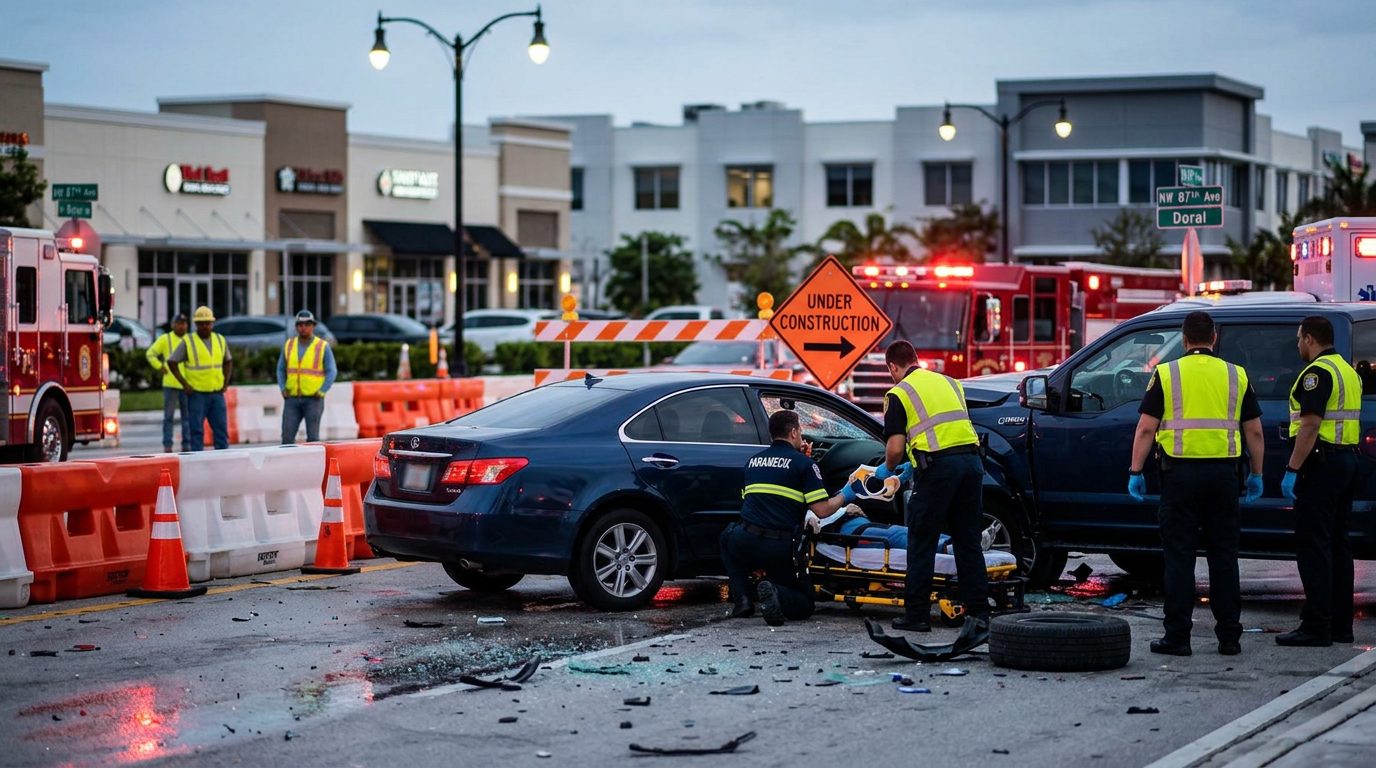
A chaotic scene unfolded early Tuesday morning in Doral when a late-model sedan traveling eastbound on Northwest 36th Street struck a concrete barrier near the intersection of Northwest 87th Avenue. The incident occurred in a heavily marked construction zone where traffic patterns had recently been shifted to accommodate utility repairs. According to witness statements, the driver appeared confused by the abrupt lane transition, leading to a secondary collision with a commercial delivery van. Miami-Dade Fire Rescue arrived shortly after the impact to extricate the sedan's occupant, who was subsequently transported to a local trauma center for evaluation of potential internal injuries.
Investigators at the scene noted that while the construction company had placed reflective pylons, the visibility of the lane-shift markings was significantly degraded by recent heavy rainfall. The force of the impact caused extensive front-end damage to both vehicles, leaving debris scattered across three lanes and shutting down the thoroughfare for several hours during the morning commute. Police are currently reviewing whether the signage met Florida Department of Transportation standards for active work zones. In many Miami accidents involving roadwork, the interplay between driver error and negligent site maintenance creates a complex web of liability that requires thorough forensic reconstruction.
For the injured parties, the path to financial recovery is governed by Florida’s strict no-fault insurance framework. While Personal Injury Protection (PIP) provides initial coverage for medical bills, it is often insufficient for long-term recovery costs following a high-speed construction zone crash. To pursue a liability claim against a negligent driver or a construction firm, the victim must meet the 'permanent injury threshold' established in Florida Statute Section 627.737. This law requires proof that the accident resulted in significant and permanent loss of a bodily function, permanent scarring, or a permanent injury within a reasonable degree of medical probability.
Exceeding this legal threshold is critical for victims seeking non-economic damages, such as pain and suffering, which are not covered by standard no-fault policies. In Doral, where heavy commercial traffic and constant infrastructure upgrades increase the risk of severe collisions, understanding these statutory limitations is essential. A victim’s initial medical evaluation plays a pivotal role in documenting the severity of the trauma to ensure the legal criteria for a bodily injury lawsuit are met. Without precise medical documentation linking the crash to a permanent condition, an insurance carrier may move to dismiss the claim based on the failure to meet the statutory threshold.
Victims of Doral construction zone accidents should prioritize a comprehensive neurological and orthopedic evaluation immediately following the event to establish a baseline for their injuries. Documenting the specific layout of the lane shift and the condition of the signage can also prove vital when challenging the defense’s version of events. Because the window to meet the no-fault threshold requirements is narrow, securing all diagnostic imaging and specialist reports is the most effective way to protect your right to a full recovery under Florida law.
Doral crash hotspots, hospitals & Florida law
Logistics & airport corridor — commercial trucks, FMCSR violations, big-rig pile-ups.
Were you involved in a similar Miami crash?
Talk to a Caraccidentmiami.com attorney now — free, confidential, 24/7.
305-244-5883

