
Little Havana School Zone Crash Involving Commercial Truck Raises Questions Over Federal Safety Compliance
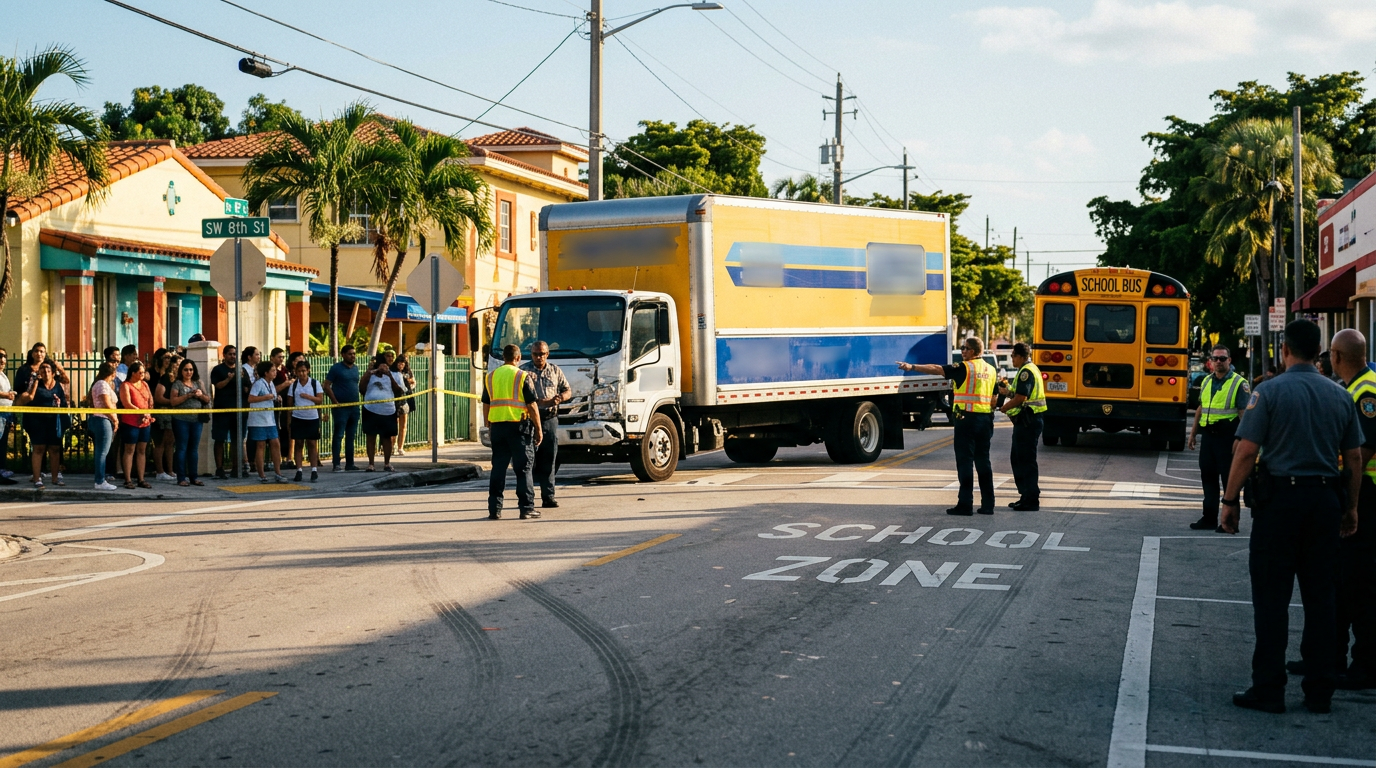
A chaotic scene unfolded early Tuesday morning in Little Havana as emergency responders arrived at the intersection of Southwest 8th Street and 12th Avenue. A commercial delivery truck reportedly failed to yield to a pedestrian crossing within a marked school zone, resulting in a collision that left a local resident with life-altering injuries. The victim was immediately stabilized by City of Miami Fire Rescue and transported to the Ryder Trauma Center at Jackson Memorial Hospital. Witnesses at the scene reported that the truck appeared to be traveling at a speed inconsistent with the active school zone flashing lights, prompting a multi-agency investigation into the driver's conduct and the carrier's safety history.
While standard passenger vehicle accidents are governed primarily by state traffic laws, collisions involving commercial vehicles introduce a complex layer of federal oversight. In this instance, investigators are scrutinizing whether the carrier complied with the Federal Motor Carrier Safety Regulations (FMCSR), specifically those found under 49 C.F.R. Part 392. These federal mandates dictate how commercial motor vehicles must be operated, particularly regarding extreme caution in hazardous conditions or high-pedestrian areas like school zones. Failure to adhere to these stringent federal standards can be used as powerful evidence of negligence in a personal injury claim, potentially holding the trucking company liable for the actions of their employee.
The legal landscape shifts significantly when a victim is struck by a vehicle weighing over 10,000 pounds. Unlike private motorists who may carry minimal insurance, commercial carriers are required by federal law to maintain high-limit liability policies. However, these companies also employ aggressive legal teams to mitigate their financial exposure. A successful recovery in a Little Havana trucking accident often depends on securing electronic logging device data and maintenance records quickly. If the driver was operating beyond their allowed hours of service or if the vehicle had faulty braking systems that violated federal maintenance codes, the burden of proof for the injured party becomes much clearer under the eyes of the court.
For those injured in Little Havana, understanding the intersection of Florida tort law and federal safety mandates is essential for a full recovery. It is not enough to simply prove the driver hit a pedestrian; one must often demonstrate that a systemic failure to follow Federal Motor Carrier Safety Regulations contributed to the event. Victims should ensure that all evidence, including the truck’s black box data and the driver’s qualification files, is preserved before it is overwritten or destroyed. Documenting the specific violations of these federal safety protocols is often the difference between a denied claim and a settlement that covers the extensive costs of long-term rehabilitation and lost wages.
Little Havana crash hotspots, hospitals & Florida law
Calle Ocho corridor — pedestrian-heavy, narrow lanes, frequent low-speed sideswipes.
Were you involved in a similar Miami crash?
Talk to a Caraccidentmiami.com attorney now — free, confidential, 24/7.
305-244-5883

