
Serious Hydroplaning Crash on US-1 Raises Questions About Miami Beach Insurance Stacking Rights
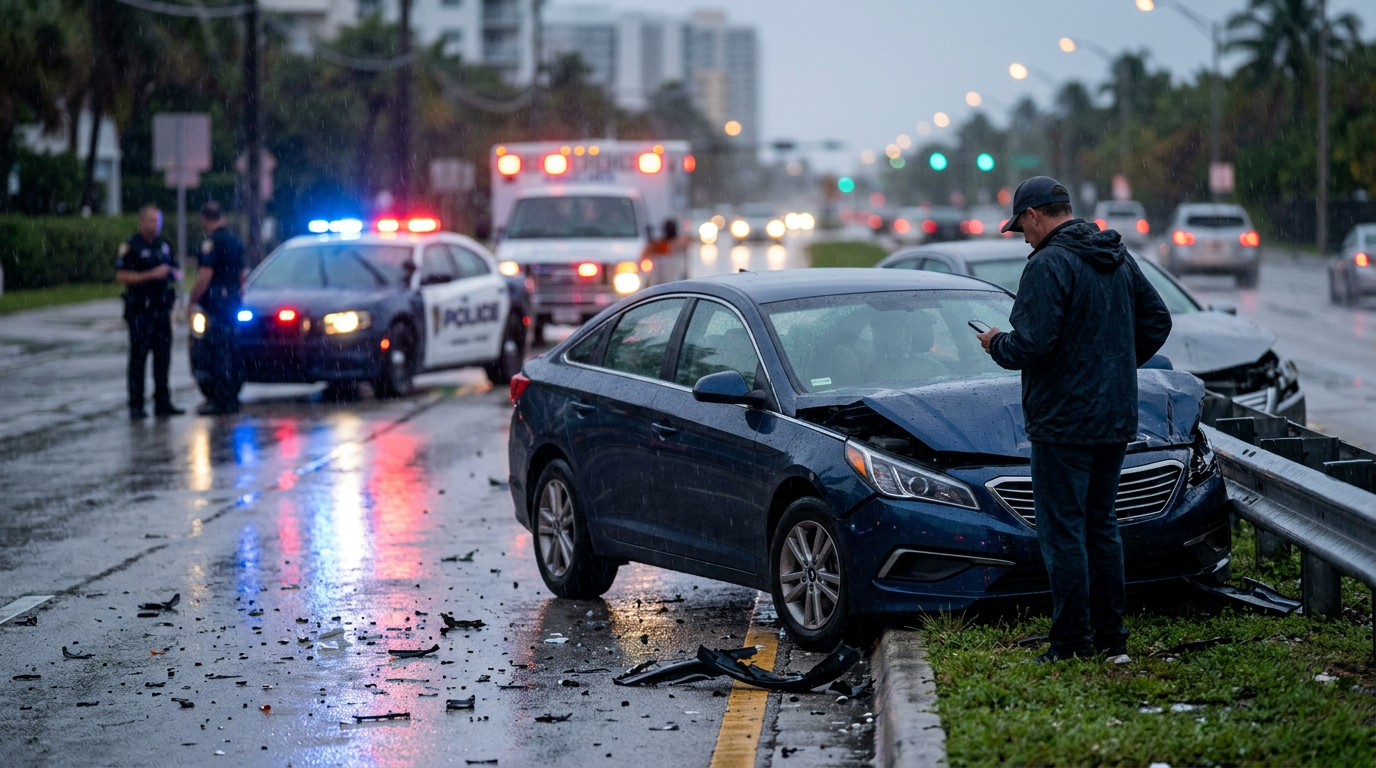
A multi-vehicle collision disrupted traffic near the MacArthur Causeway entrance in Miami Beach late Tuesday morning as heavy rains caused treacherous road conditions. According to preliminary reports, a sedan traveling southbound on US-1 lost traction and hydroplaned across two lanes, striking an SUV before spinning into a concrete barrier. First responders arrived to find significant wreckage, requiring the extraction of one driver who was subsequently transported to Mount Sinai Medical Center for evaluation of internal injuries and suspected fractures. The incident serves as a stark reminder of how quickly Miami’s seasonal storms can turn a routine commute into a life-altering emergency.
While the physical recovery for the victims is the immediate priority, the financial aftermath of such a crash often presents a second crisis. In many Miami Beach accidents involving significant property damage and bodily harm, the at-fault driver may carry only the minimum insurance required by law, which frequently fails to cover the full extent of a victim's surgical costs and lost wages. When the negligent party is underinsured, the injured party must look to their own policy to bridge the gap. This process is rarely straightforward, as insurance carriers often prioritize their bottom line over the full indemnification of their policyholders following a rainy-day collision.
Florida law provides a specific mechanism to help victims maximize their recovery through the concept of 'stacking' uninsured and underinsured motorist (UM/UIM) coverage. Under Florida Statute Section 627.727, motorists have the option to purchase stacked coverage, which effectively multiplies the available policy limits based on the number of vehicles insured under the household policy. For example, if a resident insures two vehicles with $50,000 in UM coverage each, stacking allows them to access a total of $100,000 in protection for a single accident. This is an essential safeguard in a region where a high percentage of drivers operate vehicles without sufficient liability insurance to cover catastrophic injuries.
Navigating the complexities of insurance stacking requires a precise understanding of how policy language interacts with state statutes. Victims must be aware that insurance companies often provide a lower premium in exchange for a signed waiver of stacked coverage, a choice that many drivers make without fully realizing the protection they are sacrificing. If you have been injured on a slick Miami roadway, it is imperative to have your own insurance policy professionally reviewed to determine if you have the right to stack benefits. Securing these funds is often the only way to ensure that long-term rehabilitation and medical expenses are fully funded when the at-fault driver's policy falls short.
Were you involved in a similar Miami crash?
Talk to a Caraccidentmiami.com attorney now — free, confidential, 24/7.
305-244-5883

