Serious Hydroplane Crash in Coral Gables Raises Questions Over Federal Trucking Safety Standard Compliance
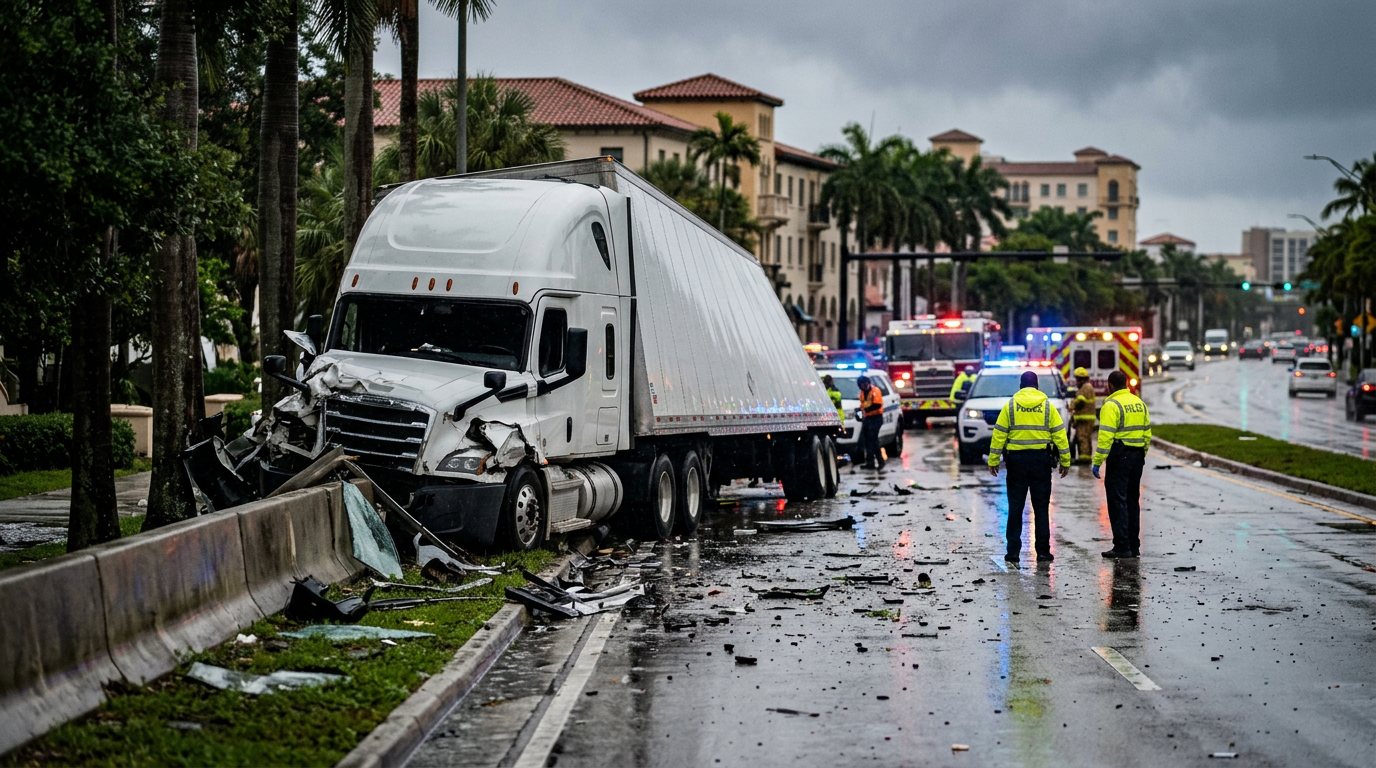
A catastrophic rain-soaked afternoon on South Dixie Highway in Coral Gables resulted in a high-speed collision involving a commercial freight truck and two passenger vehicles. Witnesses reported that as the heavy downpour intensified near the University of Miami campus, a northbound semi-trailer appeared to lose traction while navigating a slight curve. The massive vehicle hydroplaned across two lanes of traffic, striking a sedan before coming to a rest against several palm trees on the median. Emergency responders from Coral Gables Fire Rescue arrived on the scene to find several individuals trapped in the wreckage, necessitating the use of specialized extraction tools to free the victims.
Paramedics immediately stabilized the injured parties before transporting them to the Ryder Trauma Center at Jackson Memorial Hospital. The victims are currently suffering from severe orthopedic injuries and potential neurological trauma common in high-impact trucking accidents. While the wet road conditions played a physical role in the loss of control, local authorities and legal experts are looking beyond the weather to determine if the commercial driver's conduct met the rigorous standards required for professionals operating heavy machinery in the South Florida climate. The investigation remains ongoing as engineers analyze the truck's electronic logging device and tire tread depth.
In cases involving commercial vehicles, the legal landscape extends far beyond standard Florida traffic laws. Under the Federal Motor Carrier Safety Regulations, specifically 49 CFR § 392.14, commercial drivers are required to exercise extreme caution when hazardous conditions such as rain or smoke adversely affect visibility or traction. This federal mandate requires drivers to reduce their speed significantly and, if conditions become sufficiently dangerous, to cease operations entirely until the vehicle can be safely operated. When a driver fails to pull over during a Miami tropical deluge, the carrier may be held liable for a breach of federal safety standards that supersede local speed limits.
Proving negligence in a hydroplaning incident requires a deep dive into the trucking company’s maintenance records and the driver's history. Under the FMCSR, companies must ensure their equipment is in a condition that prevents such loss of control, including maintaining proper braking systems and tire integrity. For victims in Coral Gables, a successful recovery often hinges on demonstrating that the crash was not an unavoidable 'act of God' but rather a failure to adhere to these strict federal safety protocols. Identifying these regulatory violations is the primary method for ensuring that victims receive full compensation for their medical expenses and long-term rehabilitation costs.
If you are involved in a collision with a commercial vehicle during inclement weather, do not assume that the rain absolves the other driver of responsibility. Victims should focus on securing immediate medical documentation and preserving the scene via photographs if possible. Realize that trucking companies dispatch adjusters immediately to minimize their liability under federal law. Protecting your rights involves gathering evidence of the driver's speed and the vehicle's mechanical state before the carrier can clear the wreckage or overwrite digital log data that is essential for your personal injury claim.
Coral Gables crash hotspots, hospitals & Florida law
Roundabouts, banyan-canopied turns, US-1 spillover — left-turn and rear-end heavy.
Were you involved in a similar Miami crash?
Talk to a Caraccidentmiami.com attorney now — free, confidential, 24/7.
305-244-5883