Serious Pinecrest Trucking Collision on Palmetto Expressway Raises Critical Federal Safety Compliance Questions
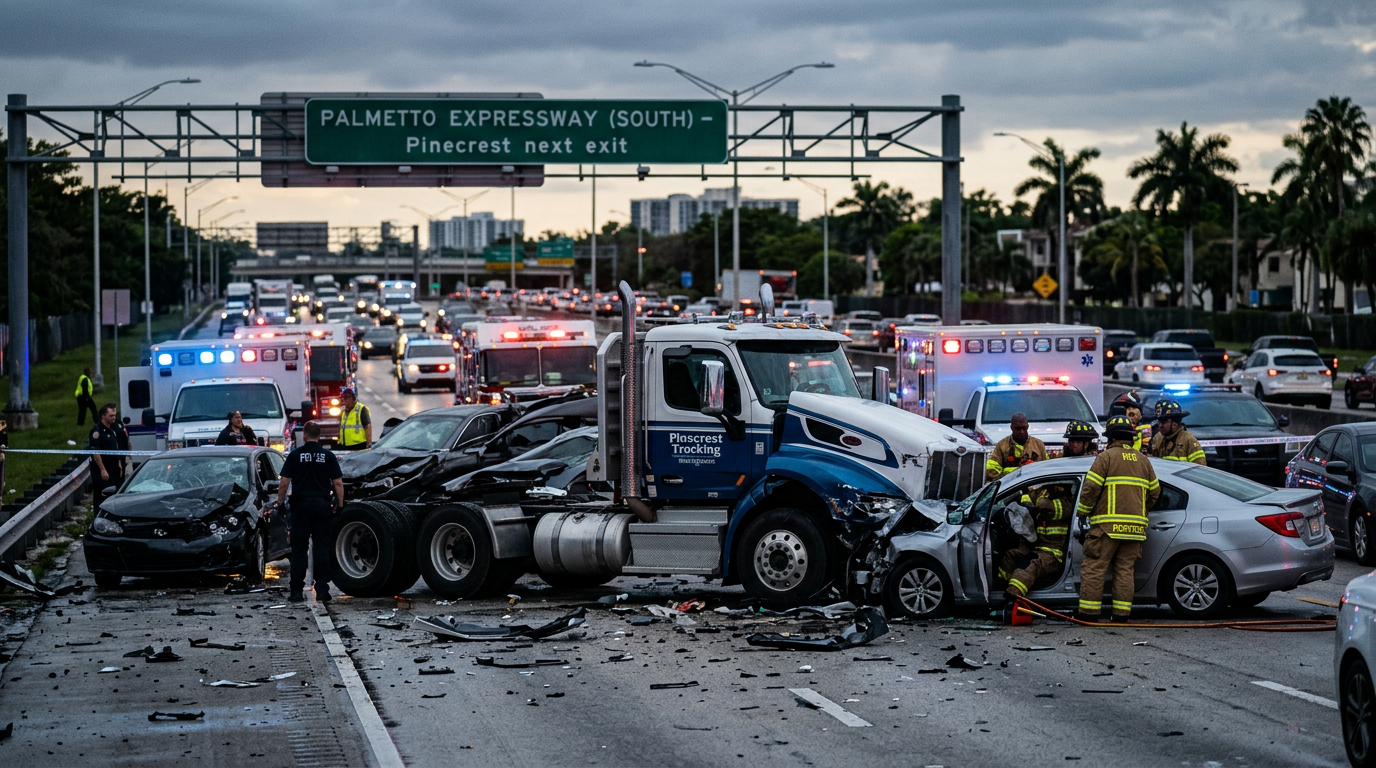
A chaotic scene unfolded Thursday morning along the southbound lanes of the Palmetto Expressway (SR-826) near the Pinecrest exit, as a commercial tractor-trailer collided with two passenger vehicles during a high-speed merge. Emergency personnel from Miami-Dade Fire Rescue arrived shortly after 9:30 a.m. to find a late-model sedan pinned against the concrete median. Paramedics worked quickly to stabilize the driver of the sedan before transporting them to the Ryder Trauma Center at Jackson Memorial Hospital. The highway remained shuttered for several hours as investigators documented the wreckage and cleared debris that stretched across three lanes of traffic.
Initial reports suggest the commercial vehicle failed to properly yield while transitioning from the entrance ramp, leading to a side-swipe collision that sent the smaller vehicles spinning. While local authorities focus on the immediate traffic citations, the legal complexity of this incident extends far beyond a simple failure to yield. Because the collision involved a heavy commercial carrier, the investigation must determine if the driver or the trucking company was in violation of the Federal Motor Carrier Safety Regulations (FMCSR). These federal standards are designed to prevent catastrophic injuries by mandating strict hours-of-service limits, equipment maintenance schedules, and driver qualification files.
Under Title 49 of the Code of Federal Regulations, trucking companies are held to a much higher standard of care than the average motorist in Miami. When a Pinecrest resident is injured by a commercial vehicle, proving negligence often involves auditing the truck’s Electronic Logging Device (ELD) and maintenance logs to identify systemic failures. If a carrier allows a fatigued driver on the Palmetto Expressway or operates a vehicle with faulty braking systems, they can be held liable for the resulting damages. These federal mandates provide a vital framework for victims to secure compensation that accounts for long-term medical care and lost wages following a devastating wreck.
Victims of trucking accidents must understand that evidence in these cases can disappear quickly, as trucking companies often begin their own internal investigations immediately after a crash. It is essential to preserve the “black box” data and driver logs that act as the primary proof of federal safety violations. If you were involved in a collision with a commercial carrier, ensure that a comprehensive crash report is filed and that all medical treatment is documented at a facility like Mount Sinai or Jackson South. Securing a legal analysis of the carrier’s compliance history is the first step in protecting your rights under both Florida statutes and federal law.
Were you involved in a similar Miami crash?
Talk to a Caraccidentmiami.com attorney now — free, confidential, 24/7.
305-244-5883