
Severe Dolphin Expressway Sideswipe in Coral Gables Highlights Critical Need for Digital Evidence Preservation
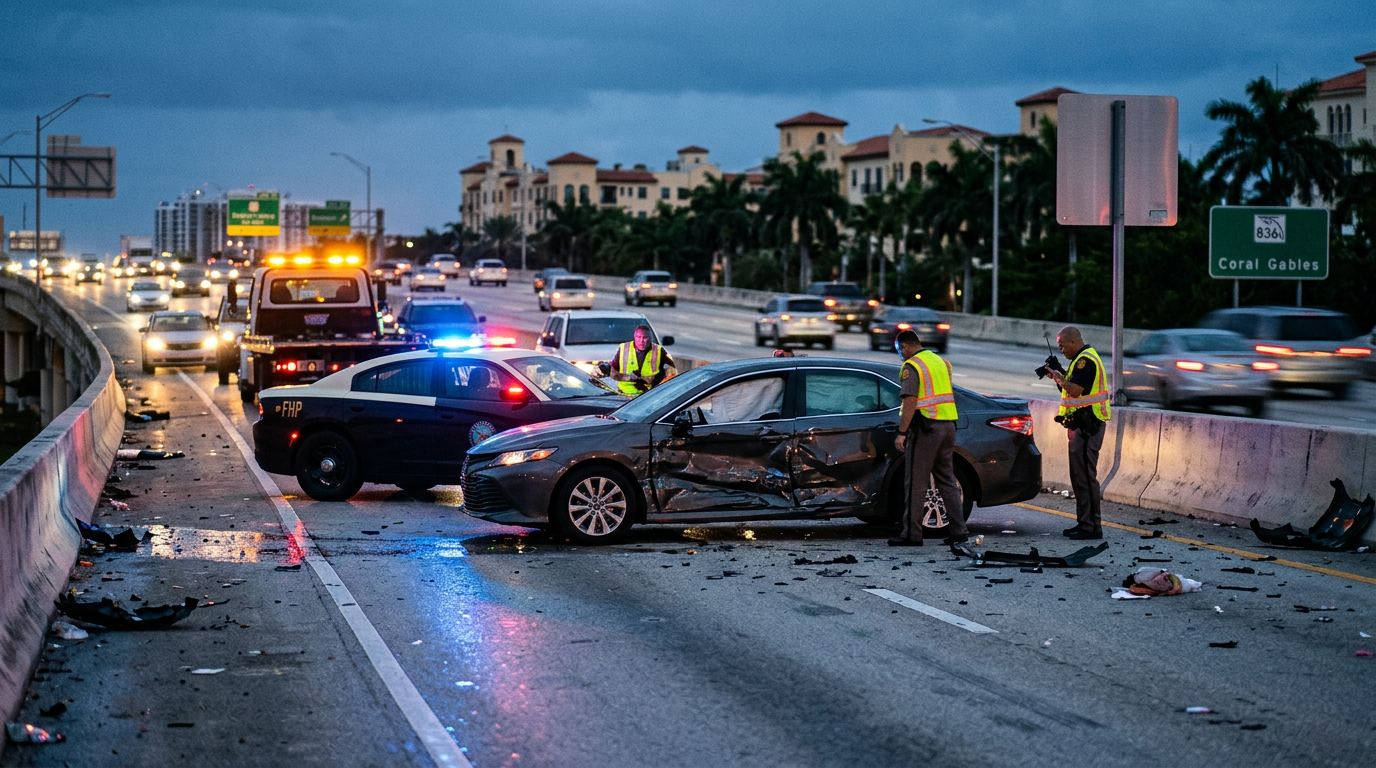
A violent sideswipe collision disrupted the morning commute on the Dolphin Expressway near the Coral Gables boundary earlier this week. The incident occurred when a late-model SUV traveling eastbound near the NW 42nd Avenue exit abruptly shifted lanes, clipping a sedan and sending it spinning into the concrete median. Miami-Dade Fire Rescue arrived shortly after to treat two occupants for neck and back injuries, eventually transporting one victim to Jackson Memorial Hospital for further evaluation. The wreckage caused significant delays as Florida Highway Patrol troopers worked to clear the lanes and document the impact points between the two vehicles.
While the initial police report may categorize the event as a failure to maintain a single lane, physical evidence on the roadway often tells an incomplete story in high-speed highway accidents. In many modern collisions, the most reliable witnesses are not the people standing on the shoulder, but the electronic modules housed within the vehicles themselves. For victims in Coral Gables, the moments leading up to the impact are often recorded by Event Data Recorders, commonly known as 'black boxes,' which capture steering input, braking patterns, and velocity at the millisecond level. Without this data, a reckless driver might claim the victim was the one who drifted into their path.
Under Florida law, this digital information is susceptible to being overwritten or destroyed if the vehicle is repaired or sold for scrap before an investigation is complete. This is why legal counsel must immediately issue 'spoliation letters' to all involved parties, including insurance carriers and towing yards. These formal notices create a legal obligation to preserve all physical and electronic evidence, including dashcam footage and ECM data. Failure to comply with these preservation demands can lead to severe evidentiary sanctions in court, preventing a negligent driver from hiding the technological proof of their distracted or aggressive driving maneuvers.
Proving liability in a sideswipe requires more than just a visible dent in a fender; it requires a proactive approach to securing the data trail left behind by modern technology. Residents injured on Miami expressways must realize that the window to capture this evidence closes the moment a vehicle is moved from a storage lot to a repair facility. By invoking strict evidence preservation protocols early in the process, accident victims ensure that the true mechanics of the crash are available for trial. The most important step for any injured party is ensuring that a formal notice is dispatched before the car's computer system is reset or the hardware is permanently discarded.
Coral Gables crash hotspots, hospitals & Florida law
Roundabouts, banyan-canopied turns, US-1 spillover — left-turn and rear-end heavy.
Were you involved in a similar Miami crash?
Talk to a Caraccidentmiami.com attorney now — free, confidential, 24/7.
305-244-5883

